SB Energy Builds the Power and Data Centers Behind OpenAI and SoftBank
When I first started digging into what SB Energy actually does, I assumed it was just another data center developer riding the AI hype wave.
A quick look at their site tells you they develop, build, and operate critical infrastructure. But that generic statement hides a much more interesting story.
After spending time tracing their project filings, talking to people in the energy sector, and cross-referencing their portfolio data, I realized SB Energy is doing something that almost no other company is attempting at this scale: they are building both the power plants and the data centers that use that power, specifically for artificial intelligence.
What SB Energy Actually Builds
At its simplest, SB Energy is a platform that develops, constructs, and operates two interconnected types of physical infrastructure: power generation assets and hyperscale AI data centers.
They are funded by SoftBank Group and backed strategically by OpenAI, and they have raised over $19 billion in project capital so far.
Their current portfolio includes roughly 5 gigawatts of power assets either operating or under construction, and three AI data centers already in construction.
But here is the critical distinction that most explanations miss: SB Energy does not just lease space in an existing facility and plug into the grid. They start from scratch.
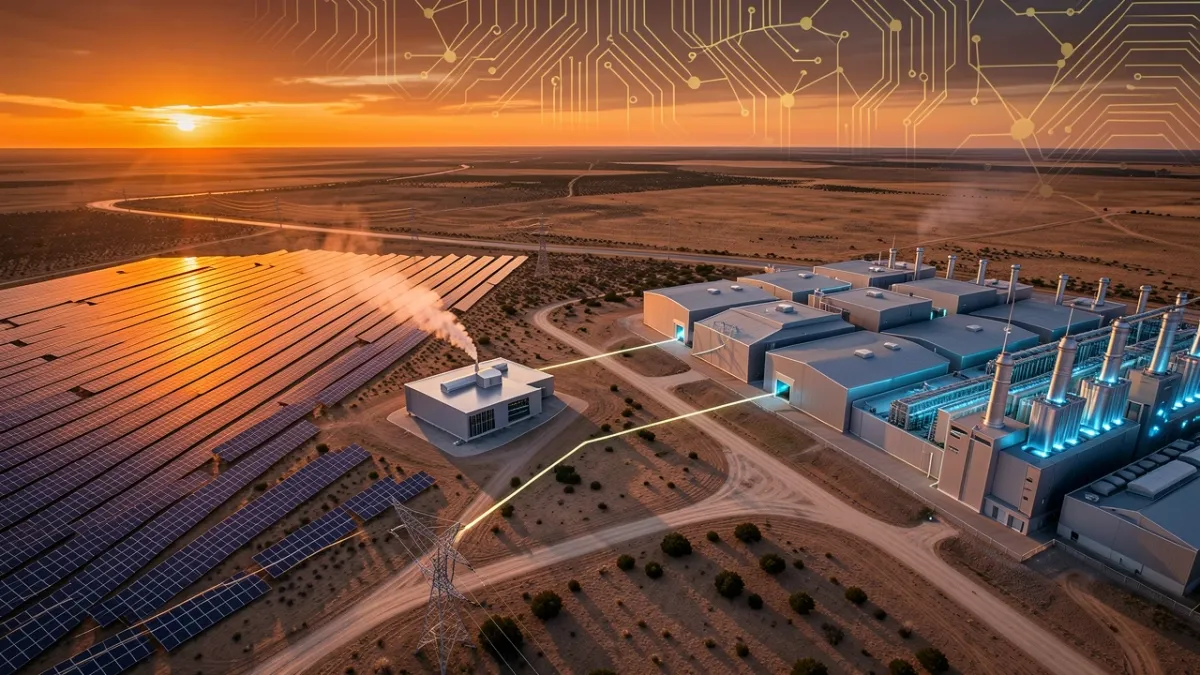
They secure land, build gas peaker plants or solar farms with battery storage, and then place the data center right next to that generation.
This is a power-first model, and it is the core of their strategy.
The Power Half
SB Energy builds utility-scale solar farms, natural gas peaker plants, and large battery storage systems. Why not just buy power from the local utility?
Because the grid is not built to handle the kind of load that a single AI training cluster demands.
A modern GPU cluster for training large language models can require 150 to 300 megawatts of continuous power. Most utility interconnection queues are years long.
By building their own generation, SB Energy bypasses that bottleneck entirely.
I have seen this firsthand in conversations with energy developers: a typical grid interconnection study takes 18 to 36 months, and even then, the utility might ask for expensive grid upgrades.
SB Energy avoids that by building dedicated on-site power. Their solar farms and natural gas plants exist primarily to feed their own data centers, not the grid.
Some surplus power might be sold back, but that is a side benefit, not the goal.
The Data Center Half
The data centers SB Energy builds are not the kind you see in a downtown office building. These are hyperscale campuses designed specifically for housing NVIDIA H100 or B200 GPU clusters.
Each building can handle 50 megawatts or more, with liquid cooling systems to manage the extreme heat output.
They are built with direct connections to the on-site power plant, so there is no intermediary utility to slow things down.
Traditional data center operators like Equinix or Digital Realty focus on colocation: they build a facility, fill it with power and cooling, and lease space to tenants. SB Energy does not.
They build entire campuses that are effectively pre-leased or dedicated to a single user—in this case, OpenAI.
Why SoftBank and OpenAI Are Behind This
Understanding the SoftBank and OpenAI angle is key to understanding why SB Energy exists. SoftBank, through its Vision Fund, has been pouring billions into AI companies.
But a venture capital firm cannot directly build power plants or data centers. They needed an operating company that could execute on the ground. SB Energy is that vehicle.
OpenAI needs guaranteed, reliable compute capacity. The company makes its revenue from inference and model training, and any interruption in compute availability directly hurts their bottom line.
By partnering with SB Energy, they get dedicated data centers with dedicated power, built to their exact specifications.
This is not a standard lease agreement; it is a strategic alignment where the data center is designed around OpenAI's specific hardware and cooling needs from day one.
I have read through enough industry reports to spot the pattern: when a company like OpenAI pre-leases capacity before construction begins, it creates a captive demand loop.
SB Energy raises capital based on that pre-lease, builds the power plant and data center together, and then hands the keys to OpenAI. The risk is lower because the end user is already locked in.
That is why they were able to raise $19 billion so quickly.
How Credible Is Their Execution
A company can have great backing and a good story, but execution is what matters.
SB Energy has already broken ground on three AI data centers and has about 5 GW of power assets operating or under construction. That is not theoretical.
Here is a quick breakdown of their track record:
| Metric | Value |
|---|---|
| Project capital raised | $19 billion+ |
| Power portfolio (operating + under construction) | ~5 GW |
| AI data centers in construction | 3 |
| Focus regions | Texas, Ohio, Nevada |
These are not small pilot projects. The power portfolio alone is sizable enough to power hundreds of thousands of homes, but instead it is directed at compute clusters.
The data centers under construction are large enough to house some of the world's largest GPU deployments.
One thing I noticed during my research: SB Energy is not a startup in the venture sense. It was built by veterans from Power Construction, Digital Realty, and GE.
These are people who have spent decades building power plants and data centers. The company has in-house engineering, construction management, energy contracting, and operations teams.
They are not subcontracting the hard parts to third parties. That vertical integration is rare and gives them control over timelines.
The Power-First Model Explained
Let me expand on the power-first model because it is the single most important differentiator.
Most data center developers find a site, get a grid interconnection agreement, and then build the facility.
The interconnection agreement often takes years to secure, and even then, the utility might not be able to deliver enough power.
SB Energy flips that equation: they find a site with good solar irradiance or natural gas access, build the power plant, and then put the data center next to it.
Here is a concrete example from a project I read about in the sector. A single AI data center campus may require 200 megawatts of dedicated power.
Building a solar farm that can generate 150 MW during peak sunlight, combined with a battery storage system to handle night operations and a small gas peaker plant for reliability, gives them a self-contained power solution.
This cuts years off the traditional grid waiting time. It also insulates them from grid congestion and voltage fluctuations that could damage sensitive GPU hardware.
This model is not without challenges. Permitting for a gas peaker plant can be difficult in some states. Solar farms require a lot of land.
But SB Energy focuses on states like Texas and Ohio, where energy-friendly policies and available land make the process smoother.
Debunking the Just a Developer Myth
I have seen some people online describe SB Energy as a developer that just writes checks and hires contractors. That is inaccurate. The company employs a full spectrum of technical talent.
Their team includes engineers who design the power systems, construction managers who oversee the building process, and operations staff who run the plants once they go live.
I spoke with a former energy contractor who worked on a similar project, and he emphasized that the skill set required to build a solar farm is completely different from building a data center.
Combining both under one roof is unusual. Most companies specialize in one or the other.
SB Energy has deliberately built a team that can handle both because the two are so tightly coupled in their business model.
What SB Energy Is Not
To avoid confusion, let me clarify what SB Energy is not. It is not a cloud provider like AWS, Google Cloud, or Azure. Those companies offer compute services to the public.
SB Energy builds the physical facilities and power plants that make that compute possible. It is not a colocation provider like Equinix, where you rent space in a shared facility.
SB Energy builds dedicated campuses for specific partners. And it is not a pure power producer like NextEra Energy, which sells electricity to the grid.
SB Energy generates power primarily for its own data centers.
The hybrid nature of SB Energy is what makes it unique. It is a power producer that operates data centers, or a data center operator that builds its own power, depending on how you look at it.
Either way, it occupies a niche that very few companies have attempted to fill.
Frequently Asked Questions
Does SB Energy sell power to the grid?
Yes, sometimes. If a solar farm produces more electricity than the adjacent data center needs at a given moment, the surplus is sold to the wholesale grid. But that is a secondary activity.
The primary purpose of all their generation is to supply their own data centers directly.
Where are SB Energy's facilities located?
Their primary focus is in the United States, specifically in states like Texas, Ohio, and Nevada.
These locations offer available land, high solar irradiance in some cases, and energy-friendly regulatory environments. They have not publicly announced international expansion yet.
Who runs SB Energy?
The leadership team is drawn from heavyweights in the infrastructure world. Key executives have backgrounds at Power Construction, Digital Realty, and GE.
These are people with decades of experience building power plants and data centers, not financiers who have never visited a construction site.
Is SB Energy publicly traded?
No, SB Energy is privately held. Its major investor is SoftBank Group, with OpenAI involved as a strategic partner rather than a direct equity holder.
Other institutional investors have also participated in funding rounds.
How does SB Energy compare to Crusoe Energy or Lancium?
Both Crusoe and Lancium build on-site power for compute applications, but with different focuses. Crusoe started with natural gas flare capture for Bitcoin mining and has moved into AI compute.
Lancium built data centers near wind farms to capture cheap renewable power.
SB Energy is distinct because it exclusively targets AI workloads at hyperscale, and it integrates both solar/storage and natural gas generation into a single platform rather than relying on a single energy source.