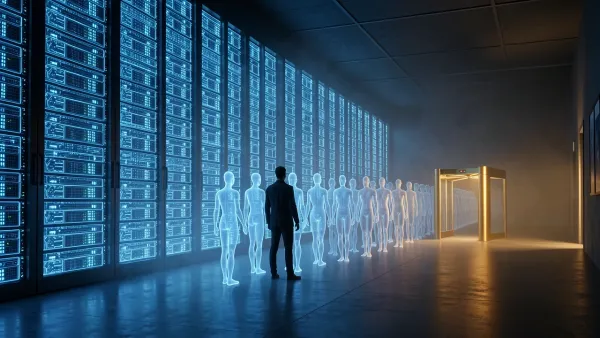
Bill Gates says current institutions can't handle AI
Bill Gates, the Microsoft co-founder turned philanthropist, has issued a stark warning: the world's existing institutions—governments, regulatory bodies, schools, and international organizations—are fundamentally unprepared for the rapid and sweeping impact of artificial intelligence.
In a lengthy essay, Gates argues that "none of our current institutions were designed to handle a technology that spreads so fast and touches so many parts of our lives." This is not a call for incremental tweaks, but a demand for a completely new architecture of governance.
Gates, who has spent the last decade and a half focusing on global health, education, and equity through the Gates Foundation, brings a rare perspective.
He has seen firsthand how institutions struggle to adapt to crises—from pandemics to climate change.
Now, he says the AI transition will be "one of the most turbulent times in human history." He points to three major risks: massive job displacement, AI-powered harm (cyberattacks, bioweapons, disinformation), and the erosion of human relationships and critical thinking skills.
"We need a plan," Gates writes, "to ensure that the good outweighs the bad."
His core critique is that current institutions are siloed, slow, and polarized. "A labor department may understand workforce disruption but not security risk.
A business regulator may understand market concentration but not AI's effects on children and teenagers." He calls for a new national and international framework—something akin to the post-9/11 reorganization but on a much larger scale.
The goal is to create "bodies that can set priorities across government agencies" and manage risks that cross borders, from AI-enabled attacks to global inequality.
Why This Matters Now
Gates is not the first to sound the alarm about AI governance, but his institutional critique is particularly pointed.
He notes that commentators often underestimate AI's impact by comparing it to past technologies like the PC or the internet.
But AI, he argues, is different: it runs on existing devices, learns in natural language, and substitutes for human cognition itself. "This time really is different," he says. "The benefits and problems are arriving at the same time."
Our analysis suggests that Gates's call for institutional overhaul signals a deeper shift.
The philanthropic and tech elites are now openly acknowledging that market forces alone cannot manage the transition.
Gates himself admits that "if someone had a credible plan for slowing down AI advances globally, I would likely support it"—but he dismisses that as implausible given geopolitical and economic incentives.
This leaves a narrow window for proactive institution-building.
What Ordinary People and Small Companies Should Do
For individuals, Gates's essay offers a roadmap for resilience. First, invest in human-skills that AI cannot easily replicate—empathy, critical thinking, and complex problem-solving.
Second, become an informed advocate. Gates urges citizens to push their leaders to start building the new framework now, before unemployment spikes and public trust erodes.
For small businesses, the message is to experiment with AI responsibly but also prepare for regulatory changes.
A "robot tax" or "Human Reserved" domains (jobs reserved for humans) could alter the cost calculus.
Small companies should plan for human-AI collaboration rather than full automation, and stay agile enough to adapt to new rules.
Gates also proposes a "Human Reserved" concept—areas where machines are deliberately kept out, such as elder care or delivering bad medical news.
This is not a protectionist fantasy, but a practical idea that could be implemented locally. Companies that anticipate these boundaries can build trust and avoid future backlash.
The Road Ahead
Gates is putting his own weight behind the effort.
He will raise the issue with lawmakers in Washington and world leaders, and the Gates Foundation will use AI to accelerate health and agriculture gains in low-income countries.
But he warns that the window for cooperative action is closing fast. "The countries that host the leading AI developers and control critical parts of the supply chain should begin meeting now to set up shared norms, before competitive pressure makes it harder for them to cooperate."
In the end, Gates's essay is a call to recognize that the AI era is not a technology problem—it's a governance problem. The institutions we have were built for a slower, more predictable world.
They are, as he puts it, "not up to the task" without deliberate redesign. The question is whether we will start building new ones before the disruption forces us into crisis mode.
Source: This article is based on Bill Gates's essay "The turbulent AI era is here. The choices we make now are critical," originally published on his blog, GatesNotes, and via the Gates Foundation.