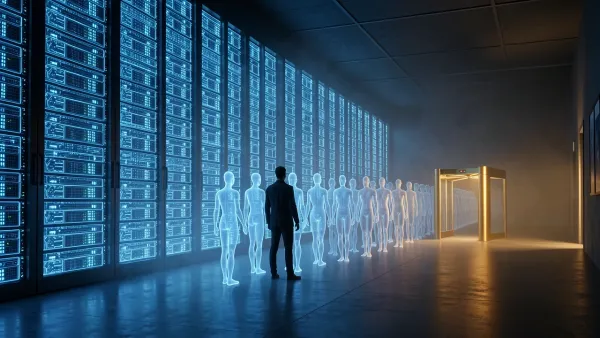
More AI agents mean more coordination work for humans
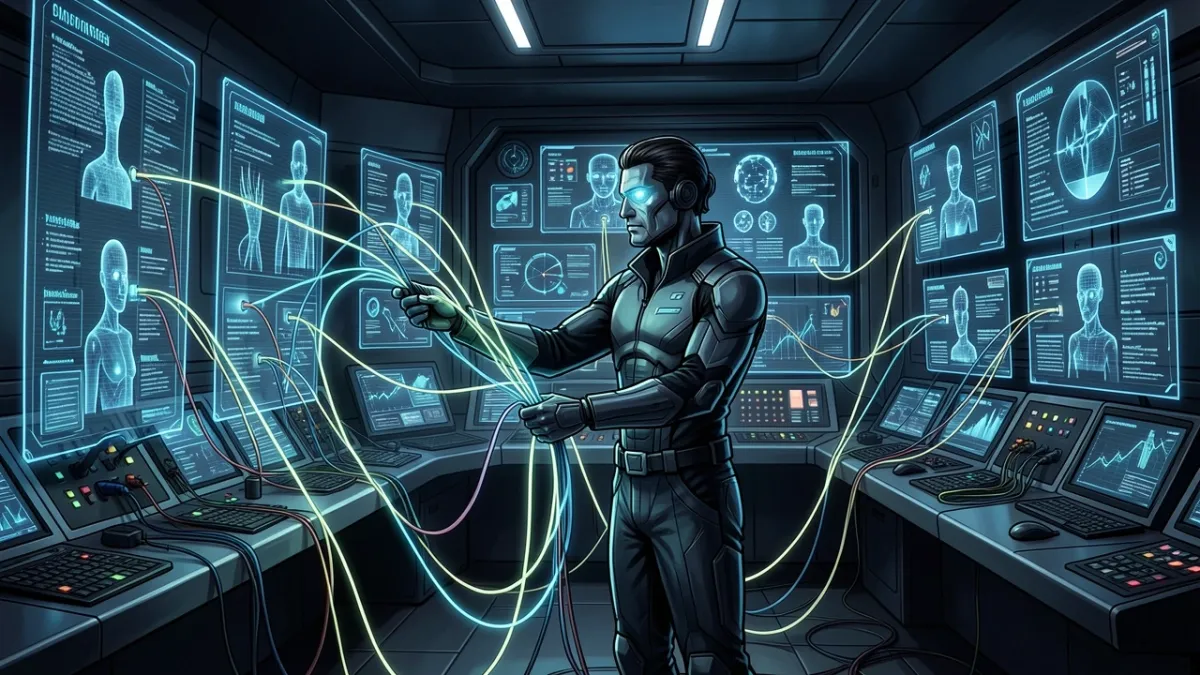
The promise of the AI agent era never included a promotion to switchboard operator—yet that is precisely what is happening inside the teams that embraced automation first.
Developers running several coding agents at once, one planning a task while another writes code and a third reviews it, are discovering that their own time is being eaten by an unexpected responsibility: carrying information between machines that cannot share it on their own.
The result is a growing paradox: the more capable and numerous AI agents become, the more coordination work falls on the humans supervising them.
According to Arick Goomanovsky, Co-Founder and CEO of BAND, people in these environments are increasingly acting as the "router"—moving context from one session to the next, deciding which agent receives what, and keeping separate workflows aligned when a chat is compacted or a session dies.
This pattern has moved well beyond software development.
Engineering, security and operations teams are layering autonomous tools onto existing toolchains, and Goomanovsky says the coordination overhead is negligible with a single assistant but scales steeply as agent counts climb.
At five or ten agents, a human ends up refereeing everything: determining what each system needs to know, shuttling outputs between sessions, recovering from restarts, and bringing each participant up to speed on what has already happened.
Production is automated. The control room is not.
One way to read this shift is as an unfinished automation job. Machines now generate, analyze and revise work faster than people can inspect the results.
But the control flow—deciding what should happen next, to whom, and in what order—remains stubbornly manual.
Every increase in machine output adds to a queue of handoffs, checks and approvals that, for now, only a person can handle.
Why don't the agents simply coordinate themselves? Goomanovsky's answer is that AI systems are probabilistic participants, not deterministic services.
Two connected agents left to converse freely may realize their discussion has become circular and still be unable to stop it.
A typical failure loop: one agent tries to convince the other to end the conversation, the other responds, and the cycle repeats.
The missing ingredients are rules around routing, relevance, state and stopping conditions—rules that, in Goomanovsky's view, do not emerge automatically from the intelligence of the agents themselves.
Predefined orchestration workflows can help when a task follows a predictable path.
But many of the jobs organizations most want agents to perform are valuable precisely because their path is unknown in advance.
An initial planning agent might hit a security question that requires a second agent with privileged knowledge. A coding agent might need to summon a testing counterpart.
A participant can fail midway and reappear later, asking for context that has changed—or that never crossed the workflow at all.
At that point, coordinating agents begins to look a lot like managing a human team, minus the social instincts humans bring to the job.
Machines need a social fabric, too
Human collaboration runs on unwritten rules.
We know who needs to be on which thread, how to brief a newcomer, when a discussion has gone far enough, and why the finance team does not belong in every engineering conversation.
Goomanovsky notes that agents lack this instinct.
For a machine workforce to function, organizations need a registry that tracks which agents exist in the environment, which owner is accountable for each one, what systems and data they are permitted to touch, and with whom they are allowed to communicate.
Agents also need preserved context across handoffs and failures, a durable record of actions, and a way for humans to inspect or halt their work at any point.
The more autonomy agents are given, Goomanovsky argues, the more important it becomes to keep a person in the approval chain—particularly when an action involves sensitive data, reaches beyond the organization's boundaries, or cannot be undone.
The valuable distinction is between judgment and clerical coordination.
A person should still settle an ambiguous situation or approve a high-risk move; what they should not be doing is ferrying context between agents all day simply because those agents lack a shared way to cooperate.
Complicating matters, enterprises will not consolidate on a single AI ecosystem.
One team may run Claude, another Codex, another a homegrown agent, while business applications quietly introduce agents of their own.
Partners and software vendors will eventually plug their own agents into these workflows.
What emerges is not one centrally designed system but a machine workforce assembled from different vendors, hosted across different environments and governed by separate owners and policies.
Without identity, permissions and clear authority boundaries, taking a human out of the handoff also removes the one person who was enforcing those boundaries.
The next competitive advantage is coordination
Our analysis suggests that organizations will increasingly be separated not by the raw capability of their AI agents, but by the quality of the systems that bind agents to one another and to people.
The first phase of the agent shift was about making individual AI tools more powerful.
The next phase, as Goomanovsky puts it, is about making agents work together without turning employees into "permanent middleware." If every interaction between systems still requires a developer to copy, translate and reconnect pieces manually, the organization has automated production while leaving the control room fully staffed by humans.
For small companies and individual practitioners in agent-heavy environments, the practical move is to start treating coordination as a first-class design problem rather than an afterthought.
Concretely:
- Inventory every AI tool in use, and write down who owns it, what it can access and what it is allowed to share. An undocumented agent is an unmanageable one.
- Standardize handoffs. Define a simple format for passing task state between sessions so that a reset or a new agent does not require a lengthy human briefing.
- Design human checkpoints into any workflow with high stakes—automation should accelerate the safe path, not remove a person from consequential decisions.
- Prefer tools with open session records and clear interfaces over tools that maximize raw capability but swallow context at every boundary.
The window to build this coordination layer is open now, before agent sprawl becomes unmanageable. Teams that wait will end up serving as their own middleware.
Teams that plan ahead may find the long-promised autonomy of AI finally worth the overhead it imposes on the humans in the middle.
This article draws on the opinion piece "More AI agents can mean more work for humans" by Arick Goomanovsky, Co-Founder and CEO of BAND.