What Your Character.AI Conversations Actually Cost the Planet
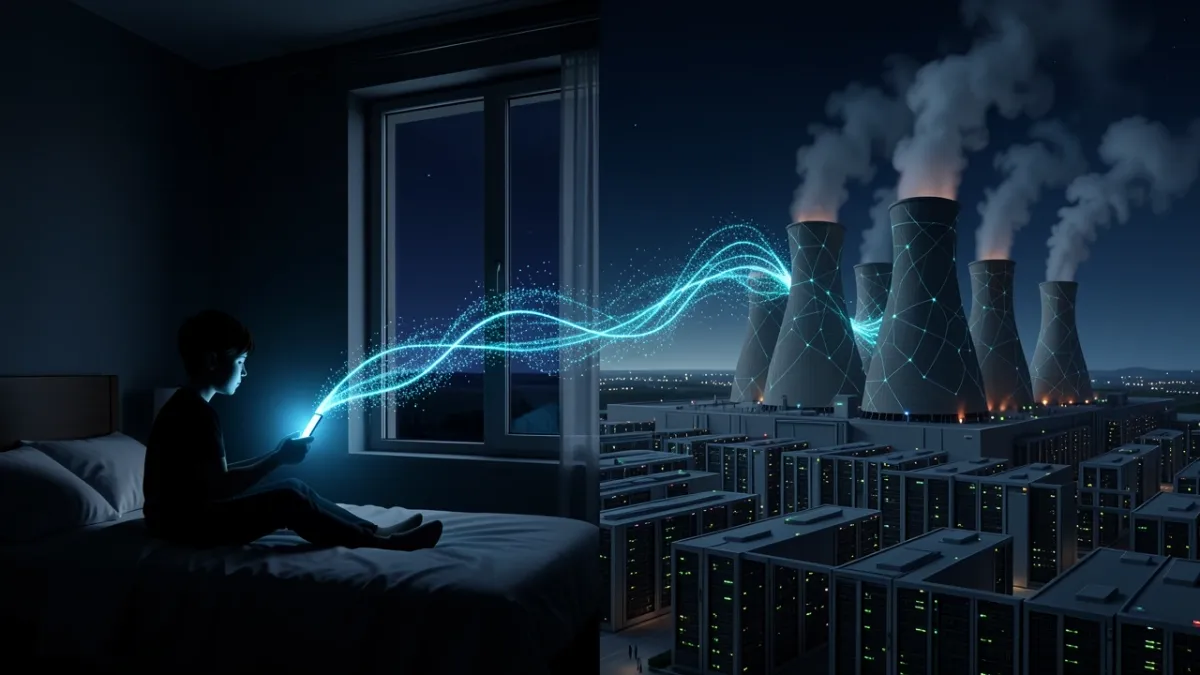
It's 1 AM and you're three hours deep in a roleplay with your favorite character. Each message feels weightless — just text on a screen.
But every single one of those messages just traveled hundreds of miles to a data center, fired up powerful computer chips, and consumed electricity before the reply came back to you.
I've been in that chair myself, so I get the pull. But I also had to confront something uncomfortable: those 1 AM conversations carry a cost that never shows up on your phone bill.
So here's the honest answer to the question you came here with: yes, using Character.AI has a real environmental cost.
But the full story is more complex than the guilt spiral you might have seen on Reddit. One session is relatively small. The collective infrastructure is enormous.
And Character.AI's design makes it heavier per session than most other chatbots.
In this article, I'll show you what actually happens behind the scenes, walk through the math so you can check it yourself, and give you realistic steps to reduce your footprint.
No guilt — just clarity.
What Actually Happens Every Time You Hit Send on Character.AI
When you type a message to a character, your words don't stay on your device. They get packed into a data packet, sent over Wi-Fi or cellular networks, and routed to a cloud server.
In Character.AI's case, that means Google Cloud infrastructure in places like Oregon, Iowa, and Northern Europe.
Once your message arrives, a GPU — the same kind of chip that powers high-end gaming — takes over.
It processes your words, looks at the entire conversation history, predicts what the character would say next, and generates a response piece by piece.
Then that reply travels all the way back to your screen.
To understand the environmental cost, you need to know the difference between two phases of AI:
- Training is the one-time process of teaching the model. It's expensive, but that cost is spread across every user who ever interacts with the model.
- Inference is the per-message cost that never stops. Every time you send a message, the model runs a fresh prediction. This is where the ongoing environmental impact comes from.
Research from Digiconomist estimates that a single AI text generation uses between 2.9 and 10 watt-hours of electricity. For scale, a Google search uses about 0.3 watt-hours.
So one AI message is roughly 10 to 30 times heavier than a search — and Character.AI messages run on the high end of that range because they involve long, complex conversations.
The key insight here: the environmental cost isn't the model's creation. It's the never-ending daily grind of millions of simultaneous conversations happening around the clock.
The Character.AI Problem Nobody Is Talking About — Its Sessions Are Built to Last
Here's the uncomfortable truth about Character.AI that almost no article on this topic covers: it's not a tool you use — it's a place you stay.
ChatGPT users typically open it, ask a question, get an answer, and close it. That's three to five exchanges. Character.AI users settle in for the evening.
The average session runs over 17 minutes, with users exchanging hundreds of messages in a single sitting. A 30-minute roleplay session can easily hit 150 messages.
This matters for the environment in a way that goes beyond simple message counting.
Every message in a long conversation carries the full context window — the model has to re-process everything said before it to generate a coherent reply.
A 500-message roleplay doesn't cost 500 times a single message. It costs more, because each new message re-processes the entire accumulated history.
I call this the compounding compute problem.
To see how different this is from other platforms, look at the session patterns:
| Platform | Typical Session Pattern | Messages per Session | Compute Intensity |
|---|---|---|---|
| Character.AI | Extended roleplay, emotional conversations | 100–500+ | High (context accumulation) |
| ChatGPT | Transactional Q&A | 3–10 | Low |
| Claude | Work and productivity tasks | 5–15 | Low |
This is the real answer to "why does Character.AI specifically matter?" It's not that each individual message is dirtier than other platforms.
It's that the product is engineered to generate vastly more messages per user than any alternative.
The endless scroll of characters, the lack of a natural endpoint, the attachment loops, the pull of "one more message" — the whole design is built to keep you typing.
The Real Carbon Math — What One Hour of Character.AI Costs, Calculated Step by Step
Most articles on this topic throw out scary numbers without showing their work. That's not helpful, so let me do the math transparently.
You can adjust these numbers with your own habits and check everything yourself.
Here's the calculation for a typical 30-minute Character.AI session:
- Start with your session size. A 30-minute session averages about 150 messages.
- Multiply by energy per message. Using the midpoint of the Digiconomist range, that's 5 watt-hours per message. So 150 × 5 = 750 watt-hours, or 0.75 kilowatt-hours (kWh).
- Convert energy to emissions. The average U.S. grid emits about 0.4 kg of CO₂ per kWh. So 0.75 × 0.4 = 0.3 kg of CO₂ per session.
- Annualize it. A daily half-hour habit adds up to roughly 110 kg of CO₂ per year.
What does that look like in everyday terms?
- One 30-minute session is roughly equal to driving 0.75 miles in an average gasoline car.
- One year of daily sessions is roughly equal to driving 275 miles — about a one-way trip from Los Angeles to San Francisco.
- One 30-minute session uses about the same energy as watching 1.5 hours of HD video streaming.
Now here's the other side of the coin. Character.AI has millions of monthly active users.
Multiply that individual footprint across the entire user base, and you get the 30,000 to 50,000 metric tons of CO₂ per year that industry analysts estimate.
That's roughly the annual emissions of 10,000 gasoline-powered cars.
But here's the part that should genuinely relieve you: your individual impact is real but modest. It's comparable to moderate video streaming — not to flying across the country.
The bulk of the environmental problem lies in systemic decisions: how data centers are powered, how efficient the models are, and whether companies disclose what they're using.
Personal reduction alone won't fix this. But collective awareness creates pressure for change.
One important caveat: these are estimates based on comparable infrastructure benchmarks. Character.AI does not publicly disclose its energy data — which is itself part of the problem.
More on that shortly.
Beyond Carbon — The Water, Hardware, and E-Waste That Never Make the Headlines
Carbon dioxide gets all the attention, but it's only one piece of the ecological picture. Let's talk about the other costs that almost never come up in the conversation.
Water
Data centers run hot. Hundreds of thousands of chips generating heat need serious cooling, and the most common method is evaporative cooling — which uses enormous amounts of water.
Google's data centers used over 5 billion gallons of water in a single year, according to reports from The Verge and Bloomberg.
A single AI conversation can indirectly be responsible for a few hundred milliliters of water when you account for the cooling load.
Scaled across millions of daily sessions, that becomes millions of gallons. In drought-prone regions, this is a more immediate concern than carbon.
Hardware manufacturing
Every GPU in those server racks had to be built before it could process your messages.
That means rare-earth mineral mining, semiconductor fabrication with toxic chemicals, and massive clean-water usage during manufacturing.
The built-in carbon of a single high-end GPU — the emissions from producing it — is hundreds of kilograms before it ever processes its first prompt.
E-waste
The AI industry's hardware refresh cycle is brutal. New model generations demand new chips, and old GPUs get retired in waves.
The world already generates over 60 million tons of e-waste every year, and AI's appetite for the latest hardware is making that worse.
Each new GPU deployment means new materials, new logistics, and more global energy.
So the full environmental price tag of Character.AI includes not just the electricity you trigger with each message, but the entire supply chain that built the machine before you ever typed a word.
Does Character.AI Actually Care? The Transparency Problem
You'd think a company running one of the most compute-intensive consumer AI platforms would have something to say about its environmental footprint.
As of the latest available information, Character.AI has published no environmental sustainability policy, no carbon targets, no energy disclosure, and no sustainability report. Nothing.
Compare that with the rest of the industry:
| Platform | Public Sustainability Policy | Cloud Partner | Renewable Energy Claim |
|---|---|---|---|
| Character.AI | None published | Google Cloud | Indirect via Google's claims |
| OpenAI | Partial (Microsoft partnership) | Microsoft Azure | Carbon-negative by 2030 pledge |
| Anthropic | Yes (Google Cloud commitments) | Google Cloud | Carbon-neutral since 2017 |
| Meta AI | Meta Sustainability Roadmap | In-house data centers | Varies by region |
There is one thing that helps: Character.AI runs on Google Cloud Platform, which has claimed carbon-neutral operations since 2017 and aims for 100% renewable energy by 2030.
That provides an indirect environmental benefit. But it doesn't replace the need for direct commitments from Character.AI itself.
Here's my honest take. The lack of transparency isn't proof of harm — but it is a real accountability problem.
If Character.AI's model is among the most compute-intensive consumer AI platforms per user, as its session data strongly suggests, its silence on sustainability matters.
Regulatory pressure is also mounting. The EU AI Act now includes environmental reporting requirements, and that pressure will only grow.
Choosing where you spend your AI time is increasingly an ethical choice about who you're funding and what standards you're rewarding.
What You Can Actually Do — Without Quitting Cold Turkey
You don't need to delete your account to be responsible. Here are six practical levers that actually move the needle.
Be grid-aware
The carbon intensity of electricity varies dramatically by time and region.
In many areas, late-night wind power makes 2–4 AM sessions significantly cleaner than early evening peak hours, when utilities often pull from fossil fuel plants.
Check your local grid mix through an app or your utility's data, and shift heavy sessions to cleaner windows when you can. This one change can cut your session's carbon footprint by 3 to 5 times.
Shorten the tail
The last 20 minutes of a 2-hour roleplay session carry the heaviest compute load because the context window has grown so large.
Setting natural session boundaries — 30 to 45 minutes — meaningfully reduces your weekly energy without ruining the experience. A well-crafted short scene often beats a rambling three-hour one anyway.
Use efficient platforms for quick questions
If you just want a fast answer or a summary, don't use Character.AI. Lightweight models like GPT-4o-mini or Claude Haiku use far less energy per query.
Save Character.AI for the emotional and creative experience it uniquely provides, and use efficient tools for everything else.
Mind your device
Your phone is actually the more efficient endpoint here. A desktop gaming PC or a laptop running at high power adds noticeable local electricity use on top of the data center cost.
Using Character.AI on your phone over Wi-Fi keeps your local contribution minimal.
Demand transparency
Email Character.AI support and ask about their sustainability policy. Post the question on social media.
Companies respond to user pressure — especially a platform whose entire business depends on user sentiment. If enough people ask, they'll have to answer.
Clean up your home electricity
The most direct way to offset your digital footprint is to make your home electricity cleaner.
Community solar programs, green energy providers, or simply choosing a utility plan with a higher renewable percentage all help — because your AI usage ultimately draws from the same grid that powers your home.
The Bottom Line — Should You Feel Guilty About Character.AI?
Let me give you the honest, balanced verdict. The environmental impact of using Character.AI is real — but it's not what the Reddit guilt spiral makes it out to be.
Yes, it has an impact. Character.AI's session structure makes it heavier than typical chatbot use.
The compounding context problem, the long sessions, the millions of active users — it all adds up to a real environmental cost.
No, you don't need to feel guilty. Your individual footprint is modest, comparable to moderate streaming.
The bulk of the environmental problem lies in systemic infrastructure choices, not individual behavior. Guilt doesn't change how data centers are powered. Informed action does.
But you should be informed. And you should act on that information where you reasonably can — shift your usage to cleaner grid hours, set session boundaries, and demand transparency from the company.
The deeper issue here is an industry that profits from planetary resources while disclosing almost nothing about what it takes. Character.AI's popularity isn't the problem.
The problem is growth without accountability.
There's also reason for cautious optimism. Models are getting more efficient through smaller, smarter architectures and better chips.
The per-message cost will likely drop dramatically in the next few years. The question is whether exponential growth in usage will outpace those efficiency gains.
The future of AI companionship doesn't have to cost the Earth — but only if we demand that its creators treat the planet as a stakeholder, not just a server farm.
Frequently Asked Questions
Does using Character.AI on my phone versus my computer change the environmental impact?
The device itself adds a small overhead — phone charging, Wi-Fi versus ethernet — but the dominant energy cost sits in the data center, not on your desk.
Your phone is actually the more efficient endpoint. A desktop gaming PC or a laptop running at high power adds noticeable local electricity use on top of the server cost.
Either way, the data center does the heavy lifting, so your device choice matters less than you might think.
Does the time of day I use Character.AI affect its carbon footprint?
Yes, significantly. Grid energy mixes fluctuate throughout the day.
In many regions, night wind power makes late-night sessions cleaner, while early evening peak demand often pulls from fossil fuel plants.
But there's a catch: in areas where the grid relies heavily on coal, night can actually be dirtier because solar power drops to zero after sunset.
The key is knowing your specific grid mix, not assuming one rule fits all.
How much water does a single extended Character.AI session consume?
Using Google Cloud data center water-usage ratios, a 30-minute session might indirectly be responsible for 100 to 500 milliliters of cooling water, depending on the facility's cooling technology.
Evaporative cooling uses far more than closed-loop systems that recycle water. Scaled across millions of sessions, this becomes millions of gallons.
Are smaller AI models the solution to Character.AI's environmental problem?
Partially. Distilled and compressed models can cut per-query energy by 50 to 80%.
But long-form roleplay depends on large context windows and strong reasoning ability, which makes the core Character.AI experience harder to shrink than transactional chatbots.
The likely compromise is hybrid architectures — small models for simple exchanges, large models for complex narrative moments.
If I switch from Character.AI to an open-source local model, does that solve the problem?
It shifts the energy cost from a shared data center to your home. If your home runs on renewable energy or off-grid solar, this can be dramatically cleaner.
If you're on a coal-heavy grid, you may just be moving the emissions, not reducing them. The math depends entirely on your local energy mix.