Behind the $2,000 API credit: How OpenAI is betting on Thai teachers and doctors as AI testers.
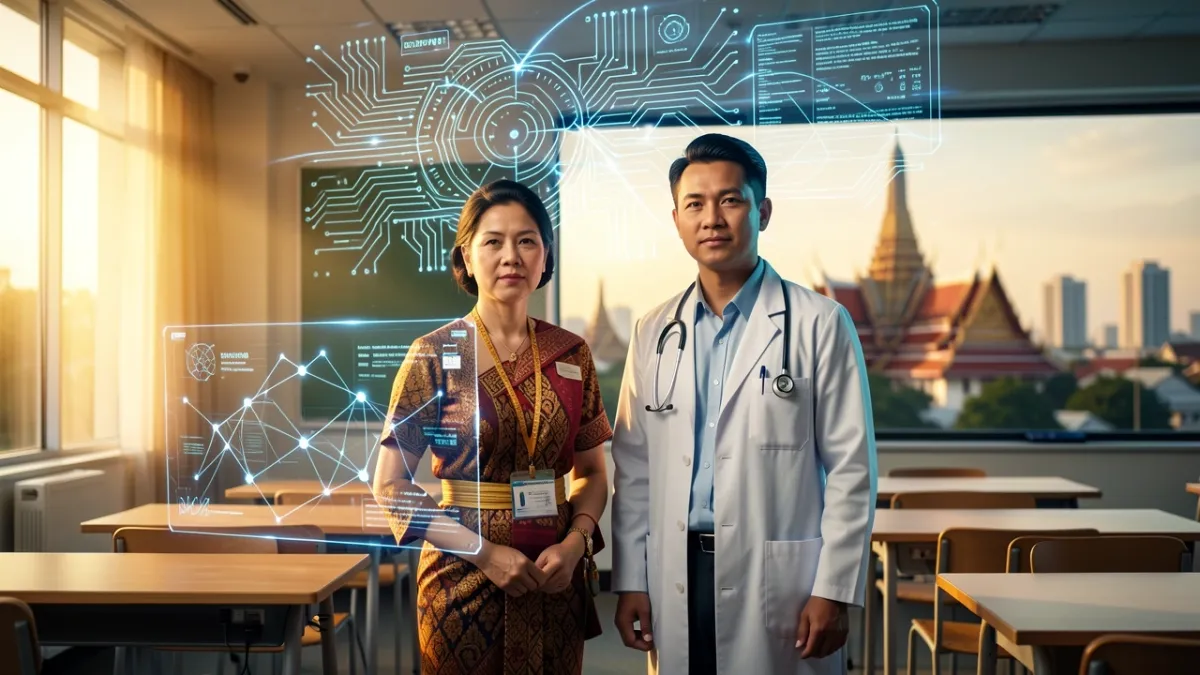
OpenAI is placing a calculated bet on Thai teachers and doctors, not just as end users but as frontline testers for its AI models, through a new accelerator that provides each startup with $2,000 in API credits.
The modest credit — worth less than a single month's rent for many Bangkok offices — is the key to a much larger strategy: embedding frontier AI into real-world healthcare and education settings where the stakes are high and failure is not an option.
The OpenAI x MHESI AI Accelerator, announced today in Bangkok, brings together ten startups working across health, wellness, and education.
Each team receives not only the API credits but also one-on-one technical guidance, access to OpenAI's latest frontier models, and a dedicated mentor for the eight-week program.
The first cohort includes five medical and wellness startups and five education-focused companies — all selected with Thailand's National Innovation Agency (NIA), the Ministry of Education, and the MHESI innovation network.
What makes this program different from typical startup accelerators is its deliberate focus on testing and validation.
OpenAI's internal data shows Thailand ranks among the top 20 countries globally for ChatGPT weekly active users, and Codex usage has grown more than 350-fold since the start of 2026.
But the company knows that a compelling demo is only the beginning. "Building a product that people can rely on is much harder," the announcement notes, pointing to the need for careful testing, real user feedback, and strong safeguards — especially in healthcare and education.
By betting on Thai teachers and doctors as testers, OpenAI gains something money cannot easily buy: contextual, domain-specific data from environments where AI mistakes can have serious consequences.
Consider CARIVA, which is developing a multilingual voice agent for hospital phone lines. The startup plans to deploy its first capability in a pilot hospital's live call flow by Demo Day.
During the accelerator, CARIVA will work with OpenAI on evaluation methods and steering strategies for its real-time speech model.
That means real patients, real phone calls, and real pressure — exactly the kind of testing that reveals edge cases and safety gaps.
Similarly, Curico is building AI-powered learning tools for children, families, and educators.
The team aims to pilot its platform in Bangkok Metropolitan Administration childcare centers — reaching more than 200 centers — and train over 200 teachers through an AI storybook workshop.
They also plan to test AI-assisted grading at Chulalongkorn University.
Here, teachers become the evaluators, feeding back on how well the models handle Thai language nuances, cultural contexts, and classroom dynamics.
Our analysis suggests this is a low-cost, high-leverage experiment for OpenAI.
A total of $20,000 in API credits across ten startups is a fraction of what a single large-scale clinical trial or educational pilot would cost.
In return, OpenAI gets early insights into how its models perform in a developing country with a rapidly aging population and a strong push toward digital transformation.
Thailand's demographic trends — increasing demand for healthcare, prevention, and independent living — make it a natural testbed for AI in sensitive domains.
For ordinary people and small companies, this accelerator offers a lesson in how to approach AI adoption. The program emphasizes that a prototype is not a product.
Each startup must set a specific product, pilot, evaluation, or commercial milestone by the end of eight weeks, and demonstrate evidence from representative users.
For small businesses or educators considering AI tools, the takeaway is clear: start with small, well-defined tests in real environments, collect user feedback rigorously, and prioritize safety and reliability over speed.
The $2,000 API credit is not the real value — the structured testing process is.
The accelerator concludes with a Demo Day in Bangkok in November, where startups will present their working products, evaluation findings, and deployment plans to investors, government agencies, hospitals, schools, and potential customers.
OpenAI and MHESI aim to establish a repeatable model that helps Thai founders build trusted AI products and take solutions developed in Thailand to the world.
If the bet pays off, Thai teachers and doctors will have shaped not just local tools but the global trajectory of AI in healthcare and education.
Source: OpenAI Blog