AI Detectors Are Not Accurate – and Here’s the Proof
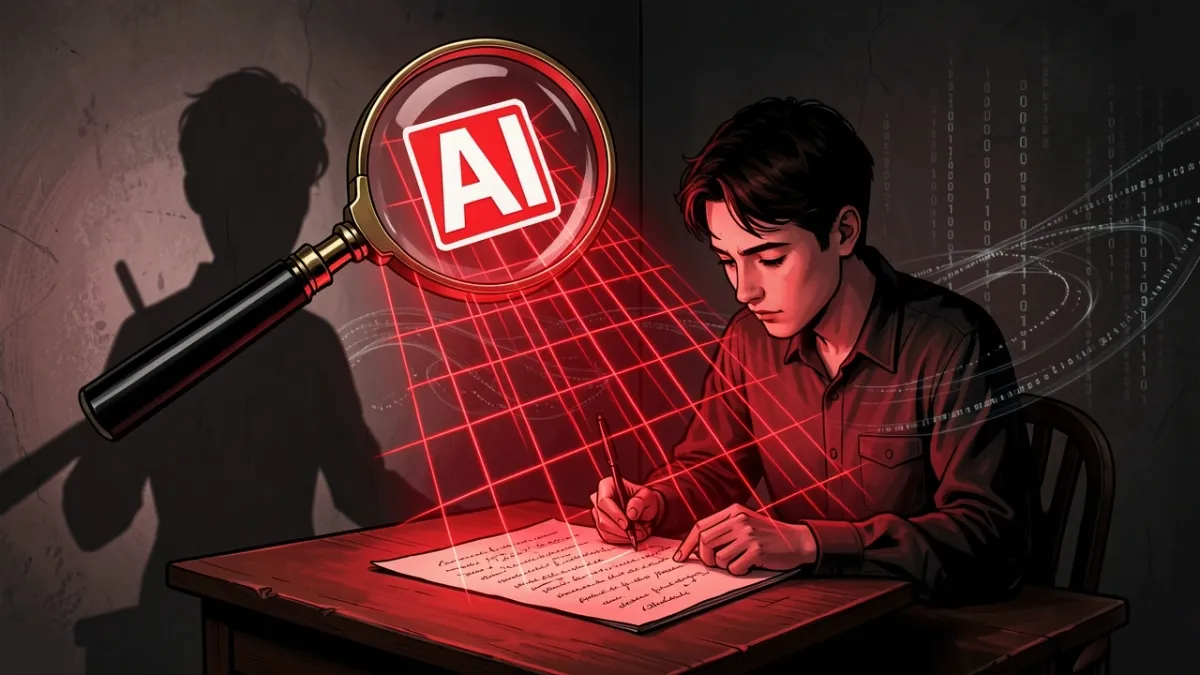
You are staring at a Turnitin report showing 80% AI probability. Panic sets in. But before you confront a student, consider this: the number you see is statistically meaningless.
No major AI detector—Turnitin, GPTZero, Originality.ai—can distinguish human writing from machine output with the certainty required for punitive action.
A 2023 MIT study pegged accuracy at 70–80%, meaning one in five students could be falsely accused. For non-native English speakers, false positive rates can exceed 60%.
This is not a tool; it is a liability.
This article is not a list of detectors. It is an evidence-based verdict: why the math fails, who gets hurt, and what actually works to uphold academic integrity in an AI-enabled world.
Why the Math Fails: The Entropy Trap
AI detectors work by measuring two statistical properties of text: perplexity (how predictable each word is) and burstiness (variance in sentence length).
Large language models are trained to generate the most probable next word, producing smooth, low-perplexity text.
Humans, by contrast, write with high entropy—we jump between formal and informal, long and short, creative and repetitive.
The critical insight: when a human writes clearly, concisely, and formally—exactly what professors reward—their writing becomes less bursty and more predictable. It begins to resemble AI.
The detector therefore punishes good writing. A student who follows a standard academic template, avoids slang, and uses transition words will be flagged more often than a student who writes sloppily.
This is the fundamental physics of the failure.
The Non-Native Speaker Penalty
ESL writers naturally produce text with lower lexical diversity (fewer unique words) and higher grammatical correctness—traits that align with AI output.
Multiple studies have shown that detectors are systematically biased against these writers.
Stanford’s 2024 analysis found that GPTZero flagged 61% of essays written by non-native English speakers as AI-generated, compared to 12% of native speakers.
The tool is not just inaccurate; it is discriminatory.
Neurodivergent writers, students with learning disabilities, and anyone who prefers a structured, formulaic style face the same bias.
The detector transforms a legitimate writing style into evidence of cheating.
The Fragility of the Maths: How to Break a Detector in 30 Seconds
If detectors were reliable, they would be robust against small changes. They are not.
The technology is so fragile that even innocent edits—adding a typo, rewording a single sentence, or running text through a free rewriter like QuillBot—can flip a score from 100% AI to 0%.
This fragility means that any student determined to cheat can bypass detection with trivial effort. They can:
- Ask ChatGPT to “add more human-like randomness” to its output.
- Insert a few intentional typos (“teh” instead of “the”).
- Use a paraphrasing tool to break the statistical patterns.
If a 13-year-old with a free browser extension can defeat a detection system, that system is not a valid tool for academic integrity. It is a paper wall, not a locked door.
What to Use Instead: From Detection to Dialogue
Rejecting detectors does not mean abandoning integrity. It means replacing a broken mathematical shortcut with pedagogical strategies that actually verify learning.
The Oral Defense
Instead of submitting to a machine for a score, mandate a brief conversation. Ask the student to explain their thesis, their research process, or their reasoning.
A student who used AI to generate content will struggle to articulate the logic behind it.
This is not a new idea—oral exams have been used for centuries—but it is far more reliable than any statistical score.
The Process Portfolio
Require submission of Google Docs version history, outlines, and rough drafts. Timestamps prove creation over time.
A genuine student will have a trail of edits; a student who pasted AI output will have a single, large insertion.
The Reverse Prompt
Shift the goal from “hiding AI” to “documenting collaboration.” Ask students to submit the prompt they used and the edits they made.
This approach acknowledges that AI is a tool, not a cheat, and encourages transparency. It mirrors how professionals use AI: as a starting point, not a final product.
Frequently Asked Questions
Can Turnitin detect AI if I rewrite the text?
No. Turnitin’s AI detector is statistical; rewriting changes word frequencies and patterns, rendering the score highly volatile or zero. Even a simple paraphrase can defeat it.
Is there a specific AI detector for code (GitHub Copilot)?
Code detectors are even less accurate than text detectors. Code is highly standardized (low entropy), and any functional solution looks identical to an AI-generated one. False positives are rampant.
Are detectors accurate on images (AI-generated art)?
Image detectors rely on metadata analysis and subtle artifacts, but they are easily fooled by rescaling, screenshotting, or adding noise filters. No major image detector is reliable for punitive use.
Why did my student get 100% AI on their hand-written essay?
Likely because the student used a very formal, structured academic tone with high predictability. The detector is punishing them for “writing like a robot” – which is ironically good academic practice.
The score reflects the detector’s bias, not the student’s misconduct.
The evidence is clear: AI detectors are not accurate. They fail on technical, ethical, and practical grounds.
The only responsible path forward is to abandon the hunt for a magical score and instead invest in assessment methods that measure genuine understanding. The machines cannot tell us who is learning.
Only we can.