AI detectors flag the Declaration of Independence as 98% AI-generated
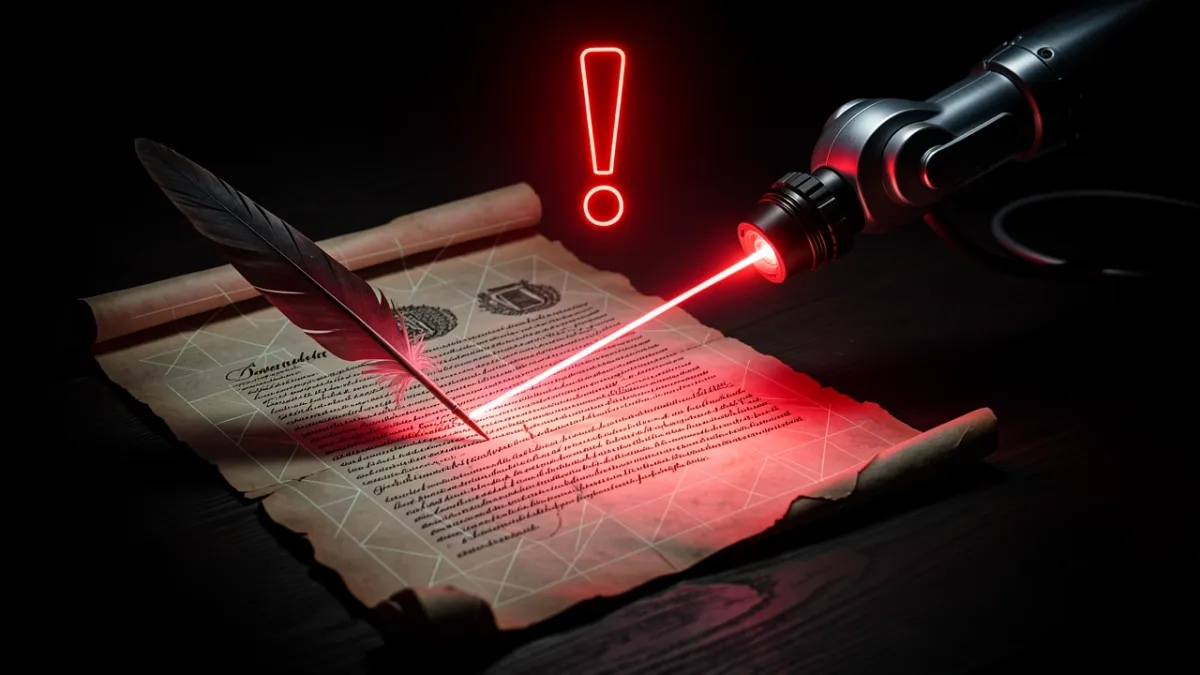
When a search engine optimization specialist copied the Declaration of Independence into an AI checker in 2024, the machine returned a verdict: 98.51 percent AI-generated.
That document, drafted by Thomas Jefferson in 1776 and edited by a committee of the Continental Congress, was deemed nearly indistinguishable from text produced by a large language model.
The result is not a glitch—it is a window into the fundamental unreliability of the tools now used to police academic and professional writing.
The false-positive problem is far from an isolated curiosity.
Vanderbilt University, after examining its own use of Turnitin’s AI detector, noted that even a low false-positive rate can unfairly flag hundreds of papers when thousands are submitted each semester.
Stanford researchers added another layer: the checkers are biased, marking non-native English writing as machine-generated far more often than native writing.
The Declaration, written in the formal, rhythmic prose of the 18th century, triggers the same pattern-matching that penalizes a student who uses semicolons or em dashes.
Our analysis suggests that the core issue is not about cheating—it is about surrendering judgment to algorithms that cannot distinguish between intentional style and statistical artifact.
The Declaration’s flagging reveals that AI detectors are trained on modern text patterns and treat any deviation from a flattened, contemporary norm as suspicious.
A polished sentence, a carefully placed colon, or a long periodic structure all read as “machine-like” to a system that has never studied rhetoric, history, or human intent.
The human cost is already visible.
Students rewrite their essays to sound clumsier, breaking up rhythm and dropping words that seem too polished—not to improve clarity, but to achieve plausible deniability before an algorithm.
A teacher can be reasoned with; a detector cannot. As philosopher John Dewey argued, genuine growth requires a responsive environment that can be questioned and pushed back against.
Editing for a machine’s approval is not adaptation—it is obedience to an unaccountable gatekeeper.
What this means for ordinary people and small companies
If you write for a living—as a freelancer, a marketer, or a small business owner—you may already be submitting work that passes through AI detectors used by clients or platforms.
The lesson from the Declaration is clear: do not trust a single automated score. If a detector flags your text, ask for a manual review or a second opinion.
Document your writing process with version histories or drafts.
For companies that rely on content moderation, resume screening, or plagiarism checks, consider that the tools you use may be punishing the very qualities—clarity, formality, careful structure—that make writing effective.
Insist on transparency: what data was the detector trained on? What is its false-positive rate for your specific domain? The burden of proof should not fall entirely on the human.
Some institutions have already acted. In 2023, Vanderbilt stopped using Turnitin’s AI detector entirely.
That is a step in the right direction, but the larger habit remains: letting a machine render a final verdict on something human, then treating that verdict as unappealable.
Until we resist that reflex, we will keep rewriting our voices to satisfy systems that cannot hear us—and flagging the very documents that founded a nation.
Source: Opinion piece by Tara G. Malhotra, Harvard Crimson, 2025. Original reporting on the Declaration of Independence test and Vanderbilt/Stanford findings.